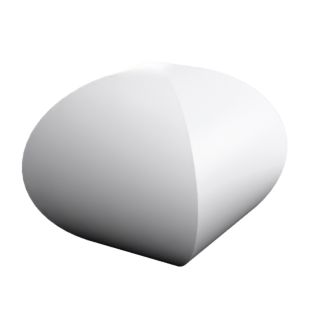
Steinmetz Solid
Steinmetz Solid is a derived surface, given by a parametrisation, immersed.
Open Steinmetz Solid in the interactive viewer →
aperiodic def-parametric derived immersed implemented
Properties
- Family
- derived
- Given by
- a parametrisation
- Curvature
- no condition imposed
- Periodicity
- not periodic
- Ends
- 0
- Embedding
- immersed
- Fidelity
- exact
Definition
No chart is stored: the boundary of a cylinder intersection is piecewise -- several cylindrical lune patches meeting along curved edges; no single chart covers it. The shipped implementation is authoritative; an unverified transcription would silently define a different surface.
Sources
Derived from the Math Art generator registries and cross-referenced to the literature; not transcribed from any gallery's compilation.
- Archimedes, "The Method of Mechanical Theorems" (c. 250 BC); T. L. Heath (ed.), "The Works of Archimedes", Cambridge, 1897.
- M. Moore, "Symmetrical Intersections of Right Circular Cylinders", The Mathematical Gazette 58 (1974), 181-185.
- K. Brecher, "Rolloids", Bridges 2023 Conference Proceedings, 345-352 (the bicylinder as a straight-line roller; local copy at research/bridges/2023/bridges2023-345/).
- The n-cylinder axis sets and their patch counts: Robert Ferreol, "Encyclopedie des formes mathematiques remarquables" (mathcurve.com), "polyedres cylindriques". Four of its five patch counts are reproduced exactly here; for the twelve truncated-octahedral axes the count is 216 rather than the published 240, since that axis set is in special position (two of the eleven cross-product directions coincide).
- Equidomoid: studied by Archimedes, and named by Leopold Hugo between 1867 and 1875; Emile Fourrey, "Recreations geometriques", 319-326.