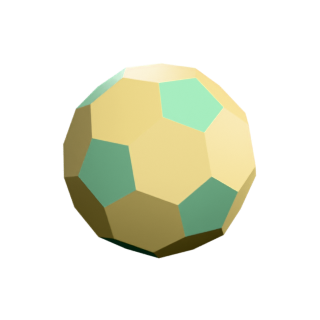
Polyhedra
471 solids
The Platonic and Archimedean solids, the Catalan duals, all ninety-two Johnson solids, the Kepler–Poinsot stars, the uniform polyhedra and their duals, compounds, zonohedra, geodesic spheres and toroids, and the notable one-off solids — Dürer's, Jessen's, Schönhardt's, Klein's regular map — with their symmetry groups, exact metrics and notation.
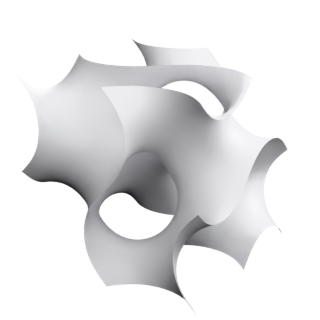
Surfaces
473 surfaces
Minimal surfaces and the triply-periodic families, algebraic and quadric surfaces, constant-curvature and constant-mean-curvature surfaces, cyclides, ruled and swept surfaces — each with the definition it is actually given by, and its curvature, topology and symmetry.
Periodic Table
127 solids
Not a selection but a census: the union of five classifications that are each provably complete — the Platonic solids, the Archimedean, their Catalan duals, all ninety-two Johnson solids and the four Kepler–Poinsot stars. Arranged by how many kinds of face each has, ending in the nine that are transitive on vertices, edges and faces at once.
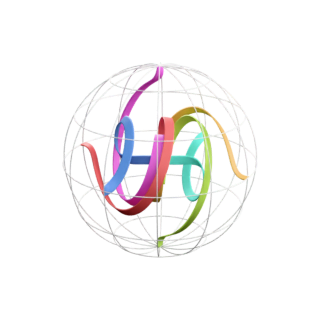
Dirac's Belt Trick
8 centres, 2 to 80 belts
A solid tied to a cage by belts that tangle after one full turn and come free after two — the geometry that lets an electron's state change sign under a 360° rotation, as neutron experiments confirmed in 1975. Scrub the turn, or play it forwards and backwards, round a cube, the Platonic solids, the snub cube or a geodesic sphere.
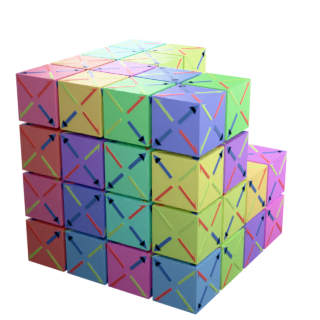
Chair44, the 3-D Monotile
1 solid, 44 legal contacts
A seven-cube chair carrying 192 tiny bumps and dents, claimed to fill space only without ever repeating — the three-dimensional answer to the question the planar “hat” settled in 2023. Grow patches by its eight-child substitution, read the matching rule as pyramids or as Goodman-Strauss's arrows, and see every contact checked against the atlas of 44.