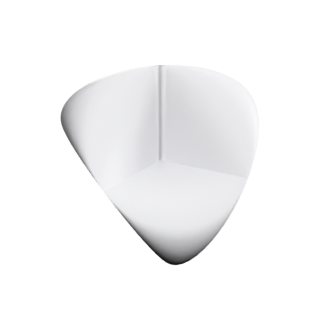
Steiner Surface (Veronese shadow)
Steiner Surface (Veronese shadow) is a topological surface, given by a parametrisation, immersed.
Open Steiner Surface (Veronese shadow) in the interactive viewer →
aperiodic def-parametric immersed implemented topological
About
The general name for Steiner's quartic images of the projective plane, of which the Roman surface is the symmetric member. All of them are quartics, all self-intersect, and all carry pinch points; they were among the first surfaces studied for their singularities rather than in spite of them.
Formula
Properties
- Family
- topological
- Given by
- a parametrisation
- Curvature
- no condition imposed
- Periodicity
- not periodic
- Ends
- 0
- Embedding
- immersed
- Fidelity
- exact
- Exactness
- elementary
Definition
projection angle fixed to the operator default 0 degrees, where the Veronese shadow is exactly the Roman surface; other angles sweep to the cross-cap
Sources
Chart reproduced numerically against the shipped implementation: fwd max 0.73 of tol, 0.0% of oracle beyond tol (tol floor 2.5 x 0.01739).
- Klein bottle: F. Klein (1882). The default classical bottle shape is built by the tube scheme of G. Franzoni, "The Klein bottle in its classical shape: a further step towards a good parametrization", arXiv:0909.5354 (2009): a tube of varying radius swept along a plane directrix, with the dumbbell-curve directrix of the paper's section 4 (which closes) as the default and its section-3 piriform directrix and the older polynomial immersion as alternatives. A converted copy is in research/papers/ surfaces-and-immersions/franzoni-2009-klein-bottle-classical-shape/.
- Mobius band (the plain ruled one-sided strip): A. F. Mobius (1858) and J. B. Listing (1858), as the standard half-twist ruled parametrization.
- Boy's surface: W. Boy, Math. Ann. 57 (1903), here via the R. Bryant - R. Kusner parametrization.
- Cross-cap and Roman surface: two immersions of RP^2 due to J. Steiner (Rome, 1844).
- Veronese surface: G. Veronese (1854-1917); see M. Berger, "Geometry Revealed", Springer 2010, p. 47. The two named projections used as the endpoints of the Steiner family here are from R. Ferreol, "Encyclopedie des formes mathematiques remarquables", mathcurve.com, chapter "surface de Veronese"; a converted copy is in research/books/ mathcurve_encyclopedie_formes_mathematiques/. Mobius band: A. F. Mobius (1858).
- Sudanese Mobius band: H. B. Lawson, "Complete Minimal Surfaces in S^3", Ann. of Math. 92 (1970), 335-374; named for Sue Goodman and Daniel Asimov (cf. G. Francis, "A Topological Picturebook", Springer 1987).