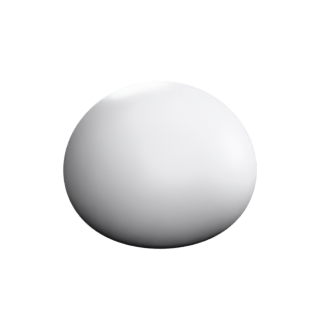
Solid of Maximal Attraction
Solid of Maximal Attraction is a surface of revolution, given by a parametrisation, immersed.
Open Solid of Maximal Attraction in the interactive viewer →
aperiodic def-parametric immersed implemented revolution tradition-classical tradition-physical
Formula
Properties
- Family
- revolution
- Given by
- a parametrisation
- Curvature
- no condition imposed
- Periodicity
- not periodic
- Ends
- 0
- Embedding
- immersed
- Fidelity
- exact
- Exactness
- elementary
Definition
r(theta) = a sqrt(cos theta) about the attracted boundary point at the origin, a = 1 fixed to the operator default; u is the colatitude theta
Sources
Chart reproduced numerically against the shipped implementation: fwd max 0.28 of tol, 0.0% of oracle beyond tol (tol floor 2.5 x 0.01561).
- D. von Seggern, "CRC Standard Curves and Surfaces" (1993), p. 304 -- Fresnel's elasticity surface.
- A. Robin (2004), plotted after M. Trott, "The Mathematica GuideBook for Graphics" (2004), p. 103 -- the paper bag surface.
- O. Knill (2017); M. A. Villarino and J. C. Varilly (2024) -- the trihyperboloid and its volume ln 256.
- C. Dupin, "Applications de Geometrie et de Mechanique", Paris 1822;
- B. Odehnal, "Ortho-Circles of Dupin Cyclides", J. Geometry Graphics 10 (2006) 1-21 -- the inversion construction and the ring / horn / spindle classification.
- J. Tannery, Bulletin des sciences mathematiques, 2e serie, 16 (1892) 190; O. Zoll, "Ueber Flaechen mit Scharen geschlossener geodaetischer Linien", Math. Ann. 57 (1903) 108-133; A. L. Besse, "Manifolds all of whose Geodesics are Closed", Springer 1978.
- R. Ferreol, "Solid of maximal attraction", Encyclopedie des formes mathematiques remarquables, mathcurve.com; local mirror chapter ch1205_attraction_2 (S:/data/math_art/references/websites/mathcurve/book/surfaces/ch1205_attraction_2.md).
- The chapter credits the Marquis de Saint-Jacques (1750) and C. F. Gauss (1830).