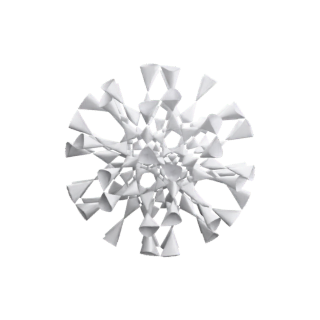
Invariant under the reflection group of the 600-cell.
Sources
Closed form reproduced numerically against the shipped implementation (math_art/surfaces/algebraic.py) over 240 sample points: matches oracle x 1 over 240 points (worst 4.66e-10).
A. Sarti, "Pencils of symmetric surfaces in P_3", arXiv:math/0106080; J. Algebra 246 (2001) 429-452 -- the dodecic is the member of the degree-12 pencil at lambda = -22/243.
O. Labs, "A Septic with 99 real Nodes", arXiv:math/0409348 (2004); Rend. Sem. Mat. Univ. Padova 116 (2006) 299-313.
S. Endrass, "A Projective Surface of Degree Eight with 168 Nodes", arXiv:alg-geom/9507011 (1995); J. Algebraic Geom. 6 (1997) 325-334.
W. Barth, "Two projective surfaces with many nodes admitting the symmetries of the icosahedron", J. Algebraic Geom. 5 (1996) 173-186
- the decic. Barth's paper is not freely available; the equation used here is the one published in Wolfram MathWorld ("Barth Decic") and in the AMS Visual Insight entry of 2016-07-01, which agree.
S. Endrass, U. Persson and J. Stevens, "Surfaces with triple points", arXiv:math/0010163 (2000) -- Theorem 5.1 gives the one-parameter family of S4-symmetric septics with 16 ordinary triple points: the orbit of length four at the coordinate tetrahedron's vertices plus an orbit of twelve generated by (-nu : mu : nu : nu). Converted copies of the freely available papers, with the constructions written out, are in research/papers/algebraic-surfaces/.