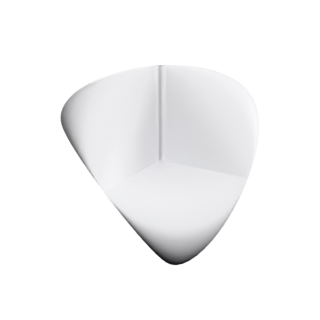
Roman Surface
Roman Surface is a topological surface, given by a parametrisation, immersed with singularities, with Td symmetry (a point group).
Open Roman Surface in the interactive viewer →
aperiodic closed closed-nonorientable def-parametric implemented non-orientable singular topological tradition-classical tradition-physical-model
About
Steiner's Roman surface, another image of the projective plane, named for the city he was visiting when he found it in 1844. Where Boy's surface is smooth, this one has six pinch points and three lines of self-intersection meeting at a triple point, which makes it far easier to write down -- a quartic -- and far less well behaved.
Formula
Properties
- Family
- topological
- Given by
- a parametrisation
- Curvature
- no condition imposed
- Periodicity
- not periodic
- Ends
- 0
- Embedding
- immersed with singularities
- Orientable
- no
- Symmetry
- Td
- Symmetry kind
- point group
- Fidelity
- exact
- Exactness
- elementary
Definition
Steiner's Roman surface: the unit sphere pushed through (x, y, z) -> (yz, zx, xy)
Sources
Chart reproduced numerically against the shipped implementation: fwd max 0.73 of tol, 0.0% of oracle beyond tol (tol floor 2.5 x 0.01739).
- J. Steiner, discovered in Rome in 1844; published posthumously by K. Weierstrass (1863).