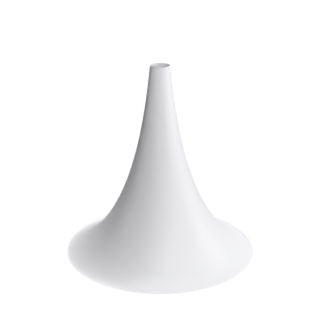
Pseudosphere
Pseudosphere is a surface of constant negative Gaussian curvature, given by a parametrisation, embedded, with a continuous symmetry group.
Open Pseudosphere in the interactive viewer →
aperiodic constant-curvature def-parametric embedded implemented k-const-negative tradition-classical tradition-physical-model with-boundary
About
A surface of constant negative curvature -- the hyperbolic counterpart of the sphere, which has constant positive curvature. It is the tractrix spun about its asymptote, and it was the first concrete model of the hyperbolic geometry that Lobachevsky and Bolyai had described only in the abstract. Hilbert later proved that no surface in ordinary space can carry the whole hyperbolic plane, so this is necessarily a fragment.
Formula
Properties
- Family
- constant-curvature
- Given by
- a parametrisation
- Curvature
- constant negative Gaussian curvature
- Periodicity
- not periodic
- Ends
- 0
- Embedding
- embedded
- Orientable
- yes
- Symmetry kind
- continuous symmetry group
- Fidelity
- exact
- Exactness
- elementary
Sources
Chart as curated in tools/surfdb/charts.py, verified numerically against the curvature condition the record claims (measured over the chart by the validator and the charts self-test).
- E. Beltrami, 'Saggio di interpretazione della geometria non-euclidea', Giornale di Matematiche 6 (1868).
- mathcurve.com, pseudosphere (mirror ch1210): 'Volume: 2/3 pi a^3; area: 4 pi a^2' -- the classical Huygens values.