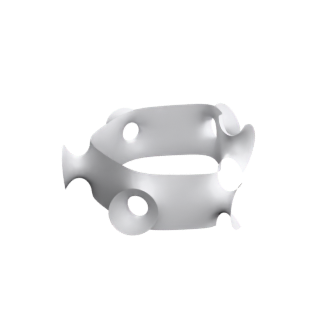
Hackman Screw-Motion 1-Noid
Hackman Screw-Motion 1-Noid is a singly periodic minimal surface, given by a Weierstrass representation, immersed, with a rod group.
Open Hackman Screw-Motion 1-Noid in the interactive viewer →
def-weierstrass immersed implemented minimal minimal-periodic singly-periodic tradition-classical
Properties
- Family
- minimal-periodic
- Given by
- a Weierstrass representation
- Curvature
- zero mean curvature
- Periodicity
- singly periodic
- Ends
- 0
- Embedding
- immersed
- Symmetry kind
- rod group
- Fidelity
- exact
- Exactness
- numerical-integral
Definition
Toroidal 1-noids: quotients of screw-motion invariant singly periodic minimal surfaces with a single catenoidal end in the quotient (the maximum principle forbids 1-noids in R3 proper). Hackman proved one exists on every conformal type of torus; the alternating fence of half-catenoids is the simplest member of the wider picture. THE SHIPPED ROW is the k = 1/3 member on tau = t + 2i with t = 0.333316172865672, re-solved from the notebook's own period condition WITH its verbatim closed-form Bonnet phase (sigma/zeta/theta with Conjugate[]s on the sheared torus). The batch-5 hypothesis phi = -arg(sigma(-k/2) sigma(k/2)) was tested against that closed form FIRST and is WRONG -- off by pi (a silent dh sign flip that would render perfectly) plus a t-dependent 6e-6 drift. Gated: period re-solve, pure phase, end loop (0,0,0), deck z+1 purely vertical h = 1.095693, screw rise exactly k h with base-point-independent offset.
Sources
Derived from the Math Art generator registries and cross-referenced to the literature; not transcribed from any gallery's compilation.
- H. Karcher, "Embedded minimal surfaces derived from Scherk's examples", Manuscripta Math. 62 (1988);
- H. F. Scherk (1835); A. Enneper (1864); M. Weber, https://minimalsurfaces.blog/ (6-Ended Scherk g0; Alternating Fence of Half-Catenoids, 2024; Fence of Catenoids; Helicoidal Karcher-Scherk; Periodic Enneper; Enneper-Scherk; Translation-Invariant Torus with 1 Enneper and 3 Annular Ends, notebook by Ramazan Yol, 2024).
- M. Weber, 'Hackman Surfaces', minimalsurfaces.blog (local mirror: minsurf/book/.../ch382_hackman_surfaces.md).
- M. Hackman, PhD thesis (as credited by the mirrored page for the construction and the classification remarks).