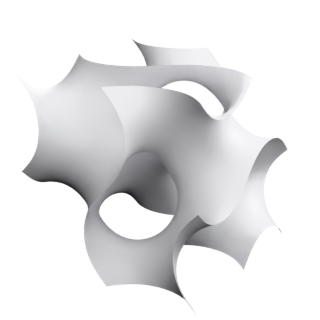
Gyroid
Gyroid is a triply periodic minimal surface, defined as a nodal algebraic surface, genus 3 per unit cell, embedded, with Ia-3d symmetry (a crystallographic space group).
Open Gyroid in the interactive viewer →
chiral def-nodal embedded has-approximation implemented minimal minimal-periodic tradition-classical tradition-crystallographic triply-periodic
About
A single surface that divides space into two interpenetrating labyrinths, neither of which ever meets the other, and which are mirror images. Alan Schoen found it in 1970 while looking for strong, light structures, and it went unproved for nearly twenty years. It contains no straight lines and no plane mirrors, which is what makes it hard: the usual way of building such a surface is to reflect a patch across its own boundary, and the gyroid gives you nothing to reflect in. It turns up in butterfly wing scales and in block copolymers.
Formula
Properties
- Family
- minimal-periodic
- Given by
- a nodal algebraic surface
- Curvature
- zero mean curvature
- Periodicity
- triply periodic
- Genus per cell
- 3
- Ends
- 0
- Embedding
- embedded
- Orientable
- yes
- Symmetry
- Ia-3d
- Symmetry kind
- crystallographic space group
- Fidelity
- approximation
Definition
Standard nodal approximation as shipped in math_art/minsurf/tpms.py. No exact definition is stored for this surface, so this approximation is all the record has; `approximates` is null rather than pointing at itself.
Sources
Derived from the Math Art generator registries and cross-referenced to the literature; not transcribed from any gallery's compilation.
- A. H. Schoen, 'Infinite periodic minimal surfaces without self-intersections', NASA Technical Note TN D-5541 (1970).
- H. Karcher, 'The triply periodic minimal surfaces of Alan Schoen and their constant mean curvature companions', Manuscripta Math. 64 (1989) -- the first proof that the gyroid is embedded.
- A. G. Weyhaupt, 'Deformations of the gyroid and Lidinoid minimal surfaces', Pacific J. Math. 235 (2008) 137-171: genus three, no straight lines or planar symmetry curves; the unique embedded member of the associate family of Schwarz P.