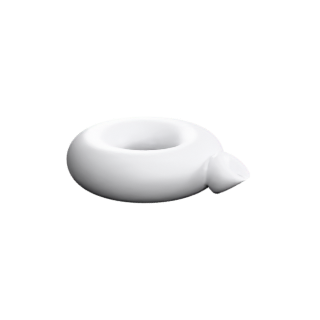
Dyck's Surface
Dyck's Surface is a topological surface, given by a parametrisation, immersed.
Open Dyck's Surface in the interactive viewer →
aperiodic closed closed-nonorientable def-parametric immersed implemented non-orientable topological tradition-classical tradition-physical-model
Properties
- Family
- topological
- Given by
- a parametrisation
- Curvature
- no condition imposed
- Periodicity
- not periodic
- Ends
- 0
- Embedding
- immersed
- Orientable
- no
- Fidelity
- exact
Definition
No chart is stored: the operator offers Dyck's surface in two renditions selected by `dyck_form` -- a three-cross-cap sphere and a three-handled torus -- built by different routines, so the record names a surface that no single chart covers; a chart for either rendition alone would silently describe half the row. The shipped implementation is authoritative; an unverified transcription would silently define a different surface.
Sources
Derived from the Math Art generator registries and cross-referenced to the literature; not transcribed from any gallery's compilation.
- Dyck's surface: W. von Dyck, "Beitraege zur Analysis situs", Math. Ann. 32 (1888), 457-512 -- the proof that a sphere with three cross-caps is the same closed surface as a torus with one.
- R. Ferreol, "Encyclopedie des formes mathematiques remarquables" (mathcurve.com), chapter "surface de Dyck" -- both forms of the surface, and Christoph Soland's octagon presentation realized in his wire sculpture "Janus bifrons" (Gymnase du Bugnon, Lausanne).
- Klein bottle: F. Klein (1882). The default classical bottle shape is built by the tube scheme of G. Franzoni, "The Klein bottle in its classical shape: a further step towards a good parametrization", arXiv:0909.5354 (2009): a tube of varying radius swept along a plane directrix, with the dumbbell-curve directrix of the paper's section 4 (which closes) as the default and its section-3 piriform directrix and the older polynomial immersion as alternatives. A converted copy is in research/papers/ surfaces-and-immersions/franzoni-2009-klein-bottle-classical-shape/.
- Mobius band (the plain ruled one-sided strip): A. F. Mobius (1858) and J. B. Listing (1858), as the standard half-twist ruled parametrization.
- Boy's surface: W. Boy, Math. Ann. 57 (1903), here via the R. Bryant - R. Kusner parametrization.
- Cross-cap and Roman surface: two immersions of RP^2 due to J. Steiner (Rome, 1844).
- W. von Dyck, 'Beitrage zur Analysis situs', Math. Ann. 32 (1888).