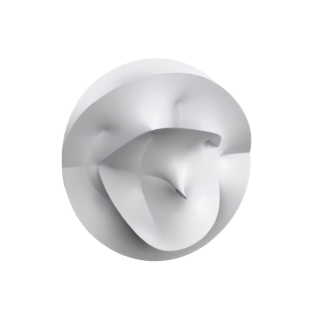
Calabi-Yau Cross-Section
Calabi-Yau Cross-Section is a topological surface, given by a parametrisation, genus varies, self-intersecting, with a point group.
Open Calabi-Yau Cross-Section in the interactive viewer →
aperiodic def-parametric implemented noncompact self-intersecting topological tradition-gallery tradition-sculptural
Properties
- Family
- topological
- Given by
- a parametrisation
- Curvature
- no condition imposed
- Periodicity
- not periodic
- Genus
- varies
- Ends
- 0
- Embedding
- self-intersecting
- Orientable
- yes
- Symmetry kind
- point group
- Fidelity
- exact
Definition
z1^p + z2^q = 1 in C^2 = R^4, projected to R^3. For the quintic threefold z0^5 + ... + z4^5 = 0 in CP^4, fixing two coordinates and normalising leaves z1^5 + z2^5 = 1: a complex curve, so a real 2-manifold. Hanson's charts are z1 = exp(2 pi i k1/p) u1^(2/p), z2 = exp(2 pi i k2/q) u2^(2/q) with u1 = cosh(xi + i theta) and u2 = -i sinh(xi + i theta), over 0 <= theta <= pi/2 and |xi| <= xi_max; u1^2 + u2^2 = 1 makes the defining equation an identity. NO SINGLE x,y,z CHART IS STORED, and not for the usual reason: the surface is p*q charts related by roots of unity, not one, and the projection (Re z1, Re z2, cos a Im z1 + sin a Im z2) depends on a chosen angle a. The shipped implementation is authoritative and checks its own residual max |z1^p + z2^q - 1| at build time.
Sources
Derived from the Math Art generator registries and cross-referenced to the literature; not transcribed from any gallery's compilation.
- A. J. Hanson, "A Construction for Computer Visualization of Certain Complex Curves", Notices of the American Mathematical Society 41, no. 9 (1994) 1156-1163 -- the parametrisation, the n^2-patch structure, the 4D -> 3D projection, the genus formula g = (n-1)(n-2)/2, the n asymptotic boundary circles, and the torus-knot generalisation z1^n1 + z2^n2 = 1 of its Eqs. (10)-(14).
- A. H. Barr, "Superquadrics and Angle-Preserving Transformations", IEEE Computer Graphics and Applications 1 (1981) 11-23 -- the real superquadric construction Hanson complexifies.
- J. Milnor, "Singular Points of Complex Hypersurfaces", Annals of Mathematics Studies 61, Princeton (1968) -- the Milnor fibration, whose fibre for z1^p + z2^q is the surface built here and whose boundary is the (p,q) torus link.
- E. Brieskorn, "Beispiele zur Differentialtopologie von Singularitaeten", Inventiones Mathematicae 2 (1966) 1-14 -- the Brieskorn-Pham singularities z1^p + z2^q.
- P. Candelas, G. Horowitz, A. Strominger and E. Witten, "Vacuum configurations for superstrings", Nuclear Physics B258 (1985) 46-74 -- why the quintic threefold is the standard example.